
What is SHA-256 Algorithm?
If you are researching how to mine Bitcoin at home, you will frequently encounter a key term while browsing miner specifications: SHA-256. It acts like a mysterious “black box” that determines your miner’s performance, the coins you can mine, and even the way the entire network operates.
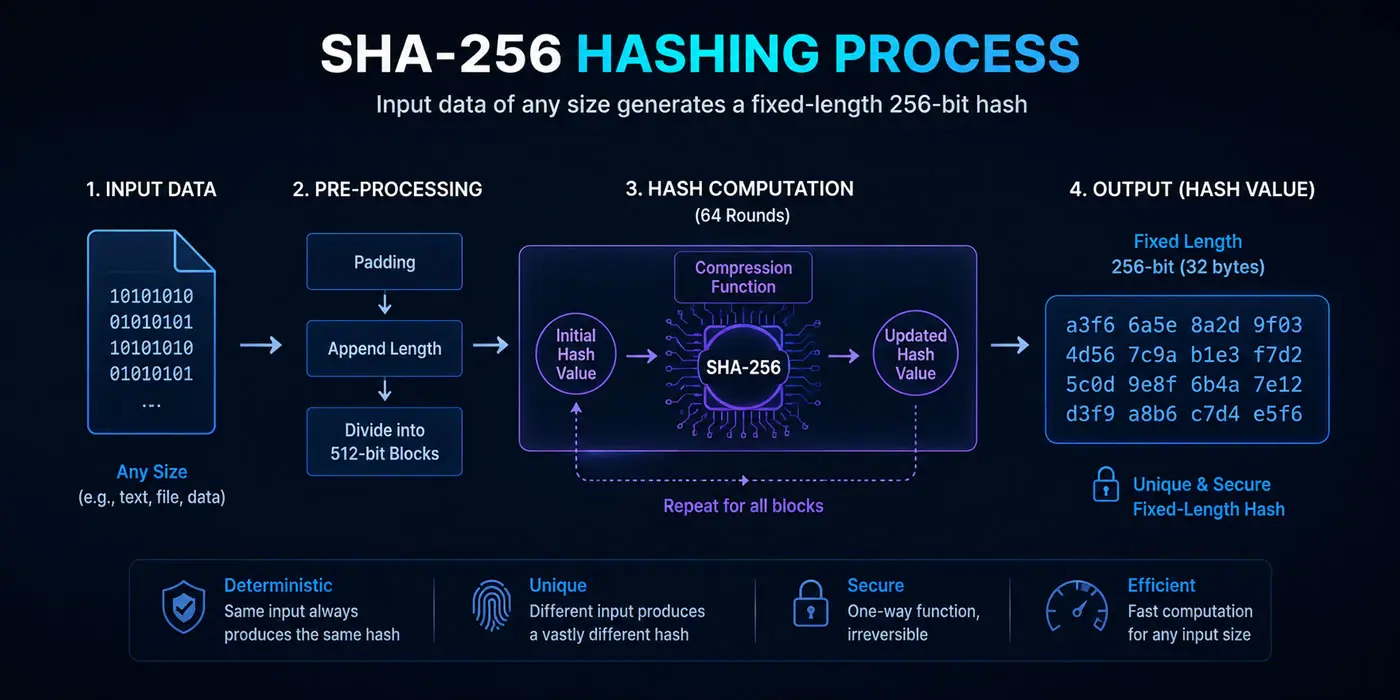
1. WHAT IS SHA-256? A SIMPLE DEFINITION
SHA-256, which stands for Secure Hash Algorithm 256-bit, is essentially a cryptographic hash function. You can think of it as a highly sophisticated “digital fingerprint generator.”
Its core function is: No matter what data you input (a file, a password, or even a blockchain’s transaction history), it will transform it into a fixed-length string of 256-bit characters, called a “hash.”
The key point is: This transformation is one-way. You can easily generate a hash from data, but it is almost impossible to reverse the hash to get the original data. Furthermore, any slight change in the input data will result in a completely different hash.
2. SHA-256’S ROLE IN BITCOIN MINING: SOLVING A “MATHEMATICAL PUZZLE”
So, how does this “digital fingerprint generator” link to Bitcoin mining? This is the clever mechanism designed by Satoshi Nakamoto, known as Proof of Work (PoW).
Finding the “Lucky Number”: Think of Bitcoin mining as a math problem. Miners must repeatedly adjust a number called a “Nonce”, combine it with other block data, and compute a hash using the SHA-256 algorithm.
Target and Condition: The generated hash must be smaller than a target value dynamically adjusted by the network. This target is exceptionally small, making it extremely difficult to find a satisfying hash.
A Lottery for Verification: Whomever finds this “lucky Nonce” first gets the right to add the block to the blockchain and receives Bitcoin rewards. This process relies entirely on brute-force attempts, much like buying a lottery ticket—luck is key to winning, but a high number of attempts (high hashrate) significantly increases your chances.
Therefore, the core job of an ASIC miner is to use its powerful chips to try different Nonces at billions of times per second, constantly computing SHA-256 hashes in an attempt to “hit” the correct one. This is the physical meaning of “Hashrate.”
3. SHA-256 Determines What Coins You Can Mine
Beyond Bitcoin, the SHA-256 algorithm serves as the consensus foundation for a wide range of other cryptocurrencies. Any digital asset built on this algorithm, such as Bitcoin Cash (BCH) or DigiByte (DGB), can be mined by SHA-256-compatible hardware.
This flexibility allows miners to adapt their strategies based on real-time market conditions. A single SHA-256 ASIC miner provides the capability to switch between supported coins, targeting the most profitable network at any given moment—a key advantage for maximizing returns.
4. SHA-256: The “Source of Power” for ASIC Miners
This fundamental difference in efficiency and processing speed is what transforms an ordinary computing device into a powerful mining machine—and this is the core engineering principle behind the entire Magicminer product line.